





One of the most encouraging developments in career and technical education is the recognition that workplace safety should not be treated as an afterthought. The Texas Education Agency’s recently adopted Occupational Safety and Compliance Lab course is a good example of a better approach: introduce students to safety while they are learning the work, not years later after bad habits, shortcuts, and assumptions have already taken root.
That matters.
For too long, workplace safety has been framed as something separate from the job. We teach the trade, then we teach the rules. We teach the task, then we hand someone a checklist. We teach production, then we remind people not to get hurt.
That order is backward.
Safety is not a side activity. It is part of how good work gets done. A competent worker does not simply know how to weld, operate equipment, handle materials, repair machinery, work around chemicals, or move through a jobsite. A competent worker understands the hazards, controls, procedures, communication, and responsibilities that come with the work.
That is why teaching occupational safety earlier makes sense.
The TEA course connects safety and compliance concepts directly to career and technical education. Students are introduced to OSHA, worker and employer responsibilities, PPE, hazard communication, Safety Data Sheets, emergency planning, industrial hygiene, ergonomics, machine guarding, powered industrial truck hazards, fire safety, incident reporting, corrective actions, and accident investigation concepts. In plain English, they are learning that work carries risk, that risk can be understood, and that good systems help people manage that risk before someone gets hurt.
That is a powerful shift.
For students, this kind of exposure can build confidence and maturity before they enter the workforce. They learn the language of safety. They learn that asking questions is not a weakness. They learn that reporting a hazard is not the same as complaining. They learn that procedures, inspections, housekeeping, training, and communication are not paperwork games. They are defenses.
For employers, the benefit is just as clear. A young worker who has already been introduced to basic occupational safety concepts is easier to onboard, easier to coach, and more likely to recognize when something does not look right. That does not replace employer training. Let’s not get silly. A high school course is not a magic force field. But it can give future workers a foundation that employers can build on, rather than starting from scratch.
There is also a cultural benefit. When students learn early that safety is part of the craft, they are less likely to see it as the “safety guy’s job” later. They are more likely to understand that safe work requires participation from workers, supervisors, managers, and safety professionals. That is exactly the kind of thinking modern organizations need.
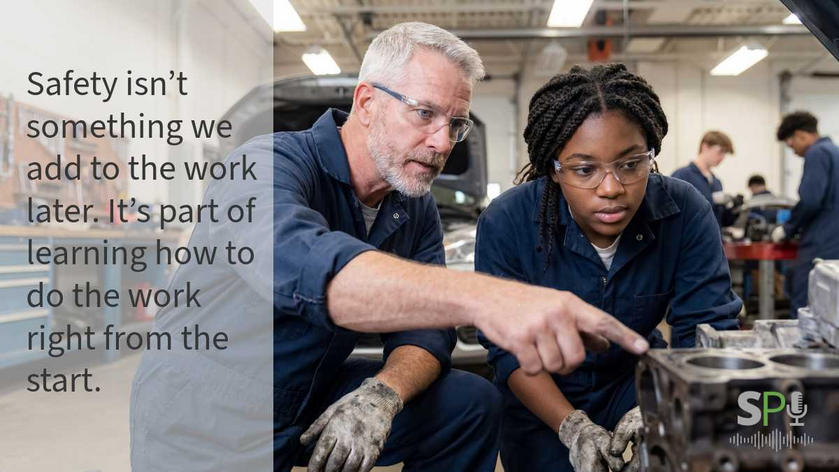
This also creates an opportunity for employers to get involved. Local businesses can partner with schools, support CTE programs, offer site visits, provide guest speakers, participate in advisory groups, and help students see how these concepts show up in real workplaces. Not sanitized textbook workplaces. Real ones. The ones with noise, moving equipment, production pressure, weather, chemicals, fatigue, awkward postures, and competing priorities.
That is where the learning gets sticky.
The best version of this is not “kids memorizing OSHA facts.” The best version is students learning how to think about work. What can hurt me? What can hurt someone else? What controls are in place? Are they enough? What do I do if something changes? Who needs to know? What does good work look like when we include safety, quality, and productivity in the same conversation?
That is the point.
Safety education should not begin after someone receives their first hard hat, badge, timecard, or paycheck. It should begin when we are teaching people what it means to do the work well.
Texas may be putting structure around something many of us in the safety profession have believed for years: the earlier we teach people that safety is part of the work, the better prepared they are to enter the workforce, and the better prepared employers are to receive them.
That is good for students. That is good for employers. And most importantly, it is good for the people who will be working next to them.
What do you think? Be sure to share your thoughts.
Source note: Based on the Texas Education Agency’s adopted 19 TAC §127.16, Occupational Safety and Compliance Lab, and TEA’s CTE program-of-study framework, which emphasizes coherent course sequences, industry-based certifications, and work-based learning opportunities.

Blaine J. Hoffmann has been in the occupational safety & health industry for 30 years and is the author of Rethinking SAFETY Culture and Rethinking SAFETY Communications. Blaine is the producer and host of The SafetyPro Podcast.